

Team Santiago or Team Montevideo?

Detail from a Quipo in El Museo Chileno de Arte Precolombino. The quipo has 15024 data points
Detail from a quipo in El Museo Chileno de Arte Precolombino in Santiago. The quipo has 15024 data points. This post is based on data, lived experience and conversations with locals

Thirty something years ago we lived in both Santiago and Montevideo. In those days the difference between the cities was notable. The Chilean economy was  booming based upon investments into mining and forest products. Santiago was vibrant, growing in front of our eyes – new cars, retail outlets, apartment blocks springing up everywhere. Uruguay, meanwhile had a sleepy steady feel, the Switzerland of South America, the summer playground of the rich and privileged from across Latin America.

Late in 2024 we spent a bit more time in both cities – it was a chance to dig a bit deeper and understand the places. Inevitably the comparisons start. Team Santiago or Team Montevideo?

In Montevideo we rented an apartment close to the beach. Montevideo is surrounded by beaches and has one of the (the?) longest ramblas in the world – a road with pavement alongside it, that runs for over 22km alongside beaches fronting the Rio de la Plata. It’s what defines the city.

View from La Ramble. Montevideo. The Sun Goes Down

Santiago meanwhile nestles in a bowl with the Andes on one side towering over the city. When we lived there the mountains were not always visible – pollution hung over the city blanking out the mountains. That’s not the case now – polluting industries and old diesel vehicles have been retired and El Plomo, the mountain that hangs over Santiago is now visible. We rented an apartment close to our former home in Las Condes.

Team Montevideo

Montevideo looks very much the same as it did in 1994 when we left. For sure there are some new smart houses on the outskirts, but the central area and old town look the same. They have seen little investment – the whole central area has a slightly decrepit air. But look carefully and there are specialist bookshops galore, art galleries, well preserved historic cafes and superb (steak) restaurants.

Cafe Brasiliero in the old town of Montevideo. A haunt of artists and authors
Cafe Brasiliero in the old town of Montevideo. An institution and  haunt of artists and authors over time

There is also a fascinating historical backdrop which I had not appreciated when we lived there, but was able to dig into during our recent trip.

José Battle y Ordóñez, was President of Uruguay from 1903-07 and again from 1911-15. He brought stability to the country in his first term, ending the series of civil wars. In his second term he introduced radical social programmes – education, healthcare (the world’s first national healthcare system), divorce reform, public infrastructure and constitutional reform. I visited a national museum – the Casa Quinta de José Battle y Ordóñez which  was his residence. The Casa is a simple house, which I had to myself – the living quarters preserved as was, and a study where you could feel the presence of the man who was instrumental in shaping the country.

Uruguay has a long and proud history around football, which the British introduced and built up. Uruguay has won the World Cup twice, and they continue to be a force in World Cups, despite being a nation of only 3.4 million people. From Beauty to Duty describes the fascinating history of the early days of football, the role of the railways and the rivalry with Argentina.

El Centenario is the national football stadium, built for the first World Cup in 1930, and now declared a historic monument of world football (admittedly by that august body FIFA). It has an extraordinary presence – completely open to the sky, and with an iconic tower. Originally conceived for 100,000 spectators its capacity is now closer to 60,000 seated. It also has a museum with a fascinating exhibition showcasing Uruguay’s triumphs in World Cups past, plus mementos of all the greats who have played there. An interesting English interest was a framed tactical sheet of the Manchester United team from the 1968 Inter-Continental Cup between Estudiantes de la Plata and Manchester Utd (played in La Bombanera in BsAs). Ah… the days before iPads.


El Centenario: the national football stadium in Montevideo. View from the lower stands towards the tower
El Centenario Stadium. La Torre de los Homenajes.
El Centenario. A partial view of the stadium
El Centenario. A partial view of the open aspect of the stadium

Tortured Histories

Montevideo also has a past hidden away in plain sight, the marks of the internal urban war between the Tupamaros and the security services during the 1960s and 1970s. During our time in Uruguay (1991-1994) the memories were clearly still too raw to learn much. There was a scrawled logo of the Tupamaros inside the house we rented there, so a former resident was clearly a supporter. But in four years living in Uruguay I only had one conversation about that period of the country’s history. Now the discussion is more open – helped no doubt by Pepe Mujica (a former Tupamaros guerrilla) being elected as President and finding himself a national treasure. There is a Museo de la Memoria and ordinary houses that were used as torture centres are now marked as such for all to see and remember.

Chile’s approach to the past has also evolved. During our time there – the last year of the dictatorship and first year of democracy – there was active and open discussion about what happened, even if the framing started from how bad the period under Salvador Allende was. Today there is an explicit attempt at remembrance for those that lost their lives and the atrocities of the dictatorship. There is an excellent museum of Memoria y de los Derechos Humanos, with groups of school children going around. However, it pointedly focusses upon the dictatorship and avoids a broader analysis of human rights and the historical injustices suffered by Chile’s 11 different indigenous groups. So the Memoria is still selective. And not everyone agrees with the rewritten history. One morning I was taking a photo of the statue of Salvador Allende next to the Moneda Palace and an elderly lady sidled up to me and hissed that he did not deserve to be remembered.

Museo de la Memoria. Santiago Chile

Team Santiago

Unlike Montevideo, the infrastructure of Santiago has changed dramatically. The historical centre is still there, with several excellent museums. But most business has moved out – it’s a shadow of its former self, and there is an edge to the streets. Chile has taken in large numbers of migrants from further north, and they have brought organised crime and gang violence, which has been a major influence in the recent (2025) elections. A new uptown centre of gravity has been created for commercial and financial activity. The former suburbs have had their traditional houses torn down to make space for office buildings and apartment blocks. Towering over the new uptown area is a 62 story skyscraper – the Gran Torre Costenera. The tallest building in South America is simply known as El Costenara.
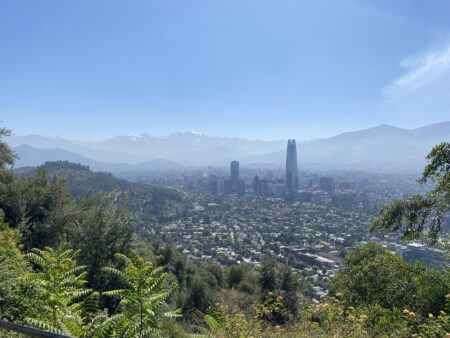
Santiago: El Costenara tower and Vitacura district. El Plomo in the background

In 1989-91 El Costenera was a mad, scary road. 6 lanes from the suburbs down to the central financial district. With a twist. It changed direction several times a day, so in the morning rush hour it was 5 lanes in the direction of the centre (and one lane up to the suburbs). In the evening rush hour it reversed to be 5 lanes back upto the suburbs. In between those times it was 3 lanes in each direction. It was controlled by a series of traffic lights at major interchanges, but there were multiple blind entry points that weren’t controlled by lights. The risky time to drive on it was around the changeover times when drivers could be caught out.  Several times I was in a wave of cars heading one way, only to find cars in the middle of the road hurtling towards us the wrong way.

Thankfully that road no longer exists. It is part of a complete remodelling of transport systems to get around the city. Back in 1989-1991 the road from the airport meandered around the outskirts of the city where brickworks and stray dogs abounded. Now the route into town is a direct highway, much of it underneath the river, disgorging travellers in double quick time into the centre. Trees have been planted on pavements to provide shade and make walking more pleasant. The metro system, which had 2 lines when we lived there, now has 7, and is a superb way to get around. It makes London look antiquated.
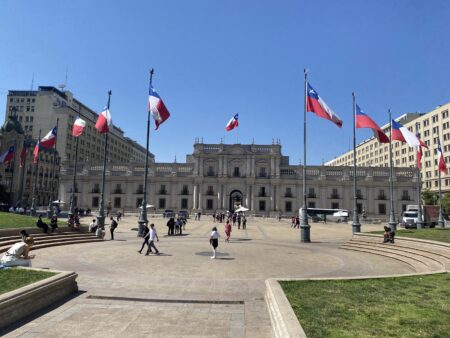
La Moneda Palace
La Moneda Palace

Santiago still has a few of the old restaurants – we were able to find an old favourite seafood restaurant, and a waitress who had been there when we were patrons 35 years ago. It was full of people appreciating food as it has always been served. But the main culinary action is now elsewhere – high class eating establishments where people are taking note of who is lunching with who. Santiago is up there with global cities in the culinary stakes.

The Verdict?

So, two very different cities. Montevideo, solid, comfortable in its skin, somewhat down at heel, but with real gems, culture, and history. The beaches full of people every evening drinking mate, and watching the sun go down, enjoying life. Santiago all shiny and new, swanky restaurants, vibrant and reinventing itself. Looking ahead and for the next deal, yet looking over its shoulder, anxious about the consequences of immigration and what it might become. These two cities may even act as broader metaphors for the direction of cities and societies on other continents.

Team Santiago or Team Montevideo?  Actually there is no need to choose. They play in different leagues. And they are both great places to live and spend some time.


Green lines. Companies, Governance, and the Biosphere

Neatly stacked logs in a forest

A recent paper on Transnational Corporations, Biosphere Stewardship, and Sustainable Futures, highlights both the critical role of, and rationale for Transnational Corporations (TNCs) to engage in corporate biosphere stewardship (covering climate, nature and other sustainability topics). Though whilst the authors observe that “TNCs provide benefits”, they also state that they “have earned a poor reputation, often for legitimate reasons.”

In over 30 years since the first Rio sustainability summit, the role of TNCs in driving biosphere stewardship has grown in importance. Initially this was through voluntary global systems such as the Forest Stewardship Council (FSC) and the Marine Stewardship Council (MSC). More recent has been the emergence of the Science Based Targets Initiative, the Task Force on Climate-related Financial Disclosure and the Task Force on Nature-related Financial Disclosure.

Whilst the FSC and MSC created democratic governance processes with representation from those impacted by the activities of companies, the latter voluntary global schemes have been built with self-appointed and/or corporate dominated governance structures.

Now doubts are creeping in about not only the governance (and subsequent rigour) of voluntary global schemes. And also the interlinked questions around the governance of TNCs in general, and their relationship to nations and national governments.

Governments are not Stakeholders

Governments have prepared national biodiversity action plans, and nationally determined (climate) contributions, based upon their national democratic mandates and national priorities. These have been rolled up to create global approaches to climate and nature rooted within international (UN) processes.

However, these national and global governmental priorities increasingly sit in a disconnected space from the global commitments of TNCs. A recent review of 24 major global companies by the Pentland Centre at the University of Lancaster did not find any evidence that companies are taking into account national biodiversity priorities in framing their biodiversity targets, and determining their actions. It is not clear therefore whether their actions are supporting government priorities or undermining them. Similarly, it is not clear if the approach of TNCs to climate is rooted in national mitigation and adaptation priorities.

Which raises a question of the relationship of TNCs towards Governments. Most TNCs have sophisticated stakeholder engagement approaches. But it is also wise to reflect that a government is not a stakeholder. It is the government.

Trans-national Governance of TNCs

Global governance of TNCs has had limited success. National oversight of their activities and actions is a fraught affair, evidenced by attempts to set a common, fair (even just) framework for taxation. There are long standing efforts to address this voluntarily via GRI, and more recently in Australia through legislation. Despite this, the pushback is significant, and even the OECD is facilitating the maintenance of secrecy. The result is that TNCs are able to ‘optimise’ their global tax affairs. This undermines national government efforts to tackle inequality.

A similar issue occurs with global climate targets where interventions and investments in carbon reductions and carbon removals takes place in the countries and places where the costs for a TNC are lowest. This is irrespective of a company’s own national level emissions, It means that there is no guarantee that they are aligned with the emission efforts and climate strategies of all the countries that they operate in. TNCs may even therefore be undermining individual (and collective) government priorities and attempts to drive forward the Paris Agreement.

Aligning TNCs with Governments

All of which suggests the need for a more active discussion on governance of TNCs. And how we can ensure that they align better with governments. The temptation is to build a new set of guidelines, perhaps based upon an expansion of the OECD Guidelines. There are however simpler ways in which this could happen:

The first is to adjust the way TNCs report. Companies setting global ambitions and targets on biodiversity and climate should report on their impacts and actions at the level of the nation states they operate in. This would provide important context to be able to judge their actions vs impacts and against the national context. And ensure that their actions align with and contribute to national biodiversity action plans and the priorities of national climate mitigation and adaptation plans. Scrutiny of this disclosure by investors and civil society would provide the necessary ratchet mechanism to drive improvement and alignment with national priorities.

Alternatively a more action orientated mechanism would be to adopt a ‘Ruggie Framework’ approach for the biosphere. In high level terms, this could mirror the three pillars of the existing Ruggie Framework replacing ‘human rights’ with ‘biosphere’, as follows,

• The state duty to protect against biosphere abuses by third parties, including business.
• The corporate responsibility to respect the biosphere.
• Greater access by victims to effective remedy, both judicial and non-judicial.

This is not to diminish the Ruggie Framework attention to human rights. Rather it is a recognition that the rigour it has brought to human rights can equally apply to the environmental sphere. It is also a recognition of the way that TNCs have adopted the Ruggie Framework to address human rights abuses – setting a global ambition, but rooting action at the national, local and individual levels.

Could a Ruggie Framework for the Biosphere Work?

It is not difficult to imagine how it would work in practice. There is plenty of guidance here, here and here. It could easily form the basis for actions and reporting.

A Ruggie Framework approach would bring a more action orientated dynamic. Companies would be forced to link actions to the analysis of the status of the biosphere and impact of their operations. It would align companies and governments, by clearly defining their respective roles. It would also tie companies more explicitly to the national jurisdictions in which they operate, forcing a nationally focussed approach that will balance the global consistency that companies can bring.

The need for consultation of stakeholders would force a discussion and alignment at a national/local level and introduce the national/local level context to actions. It would force: an honest appraisal of abuses of the biosphere; what ‘respect’ means; and shift the discourse on ‘reducing impact’ to ‘remedy’. This latter point may not be a big step: companies are already moving in this direction, with ambitions to be ‘forest positive’ or ‘nature positive’ which explicitly seeks to remedy past biosphere abuses.

Of course this does raise the question of who is representing ‘nature’. Some countries have already provided legal status to rivers and nature, whilst at least one company has given nature a board seat. There is a growing body of legal expertise able to represent nature.

TNCs have by and large adopted the Ruggie Framework on human rights, giving it the status of ‘soft law’. It is positioned in companies closer to the legal & compliance function than the corporate affairs function (which often oversees sustainability). This has an added benefit in moving companies away from the current approach of incremental improvements and a focus on burnishing reputation, to drawing new ‘green lines’ in the protection of the biosphere.

Cocoa and Poverty: Time for a New Framing

Chocolate inspires Art

In the last two to three years multinational companies have been launching detailed costed roadmaps tackling some of the biggest challenges facing society – climate, plastics, regenerative agriculture… The investments are significant, typically running to several Billion Euros/US$/CHF over a four-to-five-year period. However, we have yet to see the game changing roadmaps and public commitments to tackle inequality and human rights. This is especially important in the sourcing of agricultural raw materials from small-holder farmers.

There are some indications that attention to inequality is shortly due for a major upgrade. The World Business Council for Sustainable Development is gingerly working out business solutions to cut through an economic system that has institutionalised inequality. Corporate reporting standards setters are focussing on societal inequalities and others are co-creating a Task Force on Inequality Related Financial Disclosure. Within the cocoa sector, Nestlé recently announced its new human rights framework and roadmap. It promised action plans on its salient issues, including living income.

How things play out in cocoa will be an interesting test case of how seriously a new focus on inequality will be. The last few years has seen the focus in the cocoa industry on child labour and then recently deforestation. Yet underlying these issues, and driving them is the real issue: poverty. The sooner we have an open debate on the pathway of consequences the better: address poverty and progress will be much easier on child labour and deforestation.

Inequality in Cocoa Value Chains

Farmer incomes depend upon cocoa prices which in the last ten years have varied widely but shown no real trend. Livelihoods are desperate for the majority of smallholder cocoa farmers. Yet further along the value chain, executive pay is set at levels that provide a more than adequate guarantee for a comfortable life. For investors, dividends paid by major companies have risen over the same period. Not only are the rewards not delivered equally, neither is the risk.

Traders, manufacturers and retailers that profit from cocoa mostly have boiler plate statements on inequality that hint at a desire to fix the situation. Big companies have their own branded programme to support cocoa farmers, many of which run over a 10 year period. Cocoa Life, Cocoa Plan and Cocoa for Generations all demonstrate a lot of individual and collaborative actions, typically including money spent upon addressing child labour, building traceability and accountability (through eg certification programmes), increasing cocoa productivity, supporting communities, addressing deforestation, and paying voluntary premiums.

The annual amounts invested typically account for about 0.5% of turnover, ie not much. To put them in further perspective, the pay of the CEO and management teams of the major cocoa manufacturing companies is the same (or higher) than the total investments made to support cocoa farmers. Yet whilst there is an ongoing question on the adequacy of the of the funding compared to the scale and urgency of the task, the focus of that funding is also now in the spotlight.

For the last decade these initiatives have focussed on solving inequality through actions on productivity, costs, quality, sustainability premiums and one-off projects in communities. Some academic work by Wageningen University (WUR) and Mondelēz has helpfully synthesised the latest research findings. Yet as Nico Roozen has comprehensively laid bare, industry and academia seem stuck with an out-of-date framing.

It seems that these old-style sustainability interventions have been superb at guaranteeing future supplies for factories whilst keeping prices low. The unintended consequence has been the perpetuation of the main challenge that farmers face: poverty.

The problems of the current corporate approach seem to boil down to four things:

  1. A faith in productivity increases
  2. A failure to take into account system constraints and context
  3. A focus on deflecting discussions on prices
  4. A fixation with an inappropriate income threshold

The research by WUR/Mondelēz importantly concludes that structural changes in the industry are indeed needed. But it does not interrogate enough the other areas. So what would a new framing look like? How should a new generation of corporate approaches to cocoa and inequality be built?

Farmers, not Cocoa Farmers

Living income has been promoted for some time as the best chance to address poverty. And whilst companies proclaim support for the concept, living income has always been seen as a Trojan Horse for a discussion on price. Companies use a counter argument that the only levers that they have available to raise incomes are productivity, costs, quality and voluntary premiums. They have largely decided to put their faith in productivity.

The opportunity to increase productivity of west African cocoa farmers by a factor of two or four sounds fantastic for the casual reader, and the farmer. Yet concentrating upon productivity locks farmers into a negative supply-demand feedback loop. Unless there is a corresponding doubling or quadrupling of demand it generates an oversupply of cocoa and keeps a lid on prices.

The WUR research has provided the evidence for what has long been understood – that growing cocoa alone, however successfully, is not a route out of poverty for many farmers. For those farmers with small land areas, lack of ability to make the necessary investments, or lack of interest to develop their farm into an ‘agribusiness’, alternative development routes and crops should be the focus.

In parallel, macro-economic approaches to manage global cocoa supply and demand will also be necessary, as will Governmental approaches and interventions on land ownership and rural development.

The new framing therefore needs to put farmers, their community and national food and nutrition security first. Rather than seeing farmers who grow cocoa as ‘cocoa farmers’, they should be seen as farmers.

This needs to be seen in the context of a huge necessity and opportunity. Most countries in Africa import basic foodstuffs and wish to increase their availability of nutritious food. Development banks have significant funding programmes designed to build food and nutrition security. Targeted programmes such as the GAFSP, run by the World Bank, distribute funds to improve the resilience of smallholder farmers and improve local food availability, as well as investing in the value chains, storage facilities and routes to market to serve urban markets. Typical programmes run for five years or more and require investments of several hundred US$ per household.

To be clear, this is not just a task for the cocoa sector to lead. It needs leadership by national governments through their agriculture, economy and health departments, and carried out in partnership with communities. But it needs to be supported by the cocoa sector. Cocoa companies can play their part through a segmentation of farmers, targeting their support programmes and redesigning their commercial relationships based upon that segmentation.

Futures Contracts: Or Contracts that have a Future?

Whilst companies like to focus upon productivity, civil society and governments focus upon price. The question is what price? Cocoa prices today are determined by ‘the market’ – as reflected in futures contracts. Futures contracts reduce business risk by providing certainty of prices for manufacturers and retailers. But this transfers that risk and volatility onto the farmer and hinders the same companies own farmer support programmes. As the WUR paper indicates, futures contracts and commodity markets do not care about human rights or environmental degradation. They break the connection between the practices on the ground and the consumer, destroying any attempt by the market to adequately fund measures to address externalities such as child labour or deforestation.

So, if prices have little relation to the costs of production, the costs of doing the right thing, or the costs of delivering a decent livelihood for farmers, what’s to be done? It’s hard to escape the logic of Fairtrade’s model – a guaranteed floor price and a premium which at least puts some boundaries upon a pure market-based approach. Companies have by and large rejected these limited strictures, preferring their own voluntary approach, through which they are typical paying premia of 2-3% of the cocoa price. That is: not much.

The major manufacturing companies are all committed to source 100% of their cocoa directly from their own programmes by 2025. However, none have so far discussed how they expect to determine the mechanism by which they will set prices. In due course, regulations may force due diligence and the costs of externalities into futures contracts. Alternatively, technology may allow social and environmental externalities to be embedded into a differentiated commodity grade.

But in the absence of these developments, for companies to be credible in addressing inequality and issues such as child labour, they will need to explicitly address pricing. This may involve reducing their dependency upon commodity futures contracts for both purchases and for setting the baseline price; speeding up buying more directly from farmers producer organisations; and finding a mechanism to address actual farmer costs and externalities. Potentially, companies could adopt the same approach they use for critical raw material ingredients – a cost-plus contract-growing approach that ensures a fair return for the farmer where externalities are adequately accounted for.

Thresholds of Decency

It speaks volumes that cocoa companies and academics are still using the extreme poverty line as the baseline to talk about inequality. It gets worse – even living income is defined as what a family needs to get by on. The ambition needs to be beyond ‘getting by’. Just as executives in companies and asset managers have come to expect a decent salary and bonus, so should cocoa farmers.

The World Bank is now trying to distance itself from the extreme poverty line (US$1.90/day), using two new poverty baselines of $3.20 and $5.50 per day. The ambition of the cocoa sector should go beyond thresholds of ‘poverty’ and aspire to creating ‘decent’ lives, which suggests a daily figure closer to US$10. Clearly, paying (typically) premia equivalent to $0.20 per day is not in any way a serious attempt to address farmer incomes. Neither are ‘proud’ claims of supporting the LID of US$400/T – equivalent to about US$1/day for most farmers. Rather than premia being seen as a ‘top up’ they need to be seen more like a universal basic income. Payments for cocoa production are then ‘on top’. Not unlike the (virtually guaranteed) bonuses on top of the guaranteed salaries enjoyed by those employed by companies.

A word on carbon markets. These are seen by some as an opportunity for cocoa farmers. They are, but not at the expense of making the economics of cocoa cultivation stand on its own two feet. Carbon payments (for soil carbon or trees standing) need to be seen as a one-off bonus for farmers. A windfall, over and above what cocoa cultivation can pay them. They deserve an upside for once.

Such changes indicate a cocoa sector that needs to recognise the need to work on a ‘just transition’. This is unlikely to be a win-win. Reducing risks for farmers will not be without its costs for companies. But this is coming anyway: the transition risks associated with addressing or not addressing livelihoods are building. The continued industry focus on productivity and narrative on prices is increasingly looking like diversionary tactics to avoid taking those hard decisions.

The Next Wave of Corporate Commitments

So back to corporate programmes on human rights, inequality and cocoa. If the ambition of a new round of human rights action plans mirrors that on climate and regenerative agriculture, then a significant corner could be turned.

The typical 0.5% of turnover per annum spent on cocoa programmes will need to increase to somewhere in the order of 5%. Possibly more. The cocoa programmes of the future will fund a universal basic income for cocoa farmers, contribute to farm & food diversification, as well as renewed efforts on tackling child labour, deforestation etc.

How to pay for that? Well that’s for the company management to think through. Margins on cocoa manufacturing are in the range of 10-17% and clearly offer some room for a downward reset. As does pricing. The price range of the same or equivalent products in my local shops is 10-20%. So much for ‘price points’. Right now (January 2022), with inflationary pressures in the economy and food value chains, it’s an ideal moment to increase consumer prices to adequately fund new programmes.

This will of course present challenges for companies: corporate cocoa agronomists will need new skills to help farming communities and producer organisations grow new crops and access new markets; finance teams will need to ensure that the annual accounts can reflect the restructuring and investment that’s needed; marketing departments will need to consider how to move chocolate more up-market; and investor relations teams will need to provide investor guidance on these value enhancement/risk mitigation measures.

Above all, companies will need to evolve their reporting away from input activities (eg number of farmers trained, number of trees planted) and rather discuss and report upon outcomes and impacts. Particularly, the numbers of farming households in cocoa areas that have a decent standard of living, how they have remedied poverty and inequality in communities they are sourcing from, and the contribution they have made to solving the system level challenges holding back cocoa growing communities.