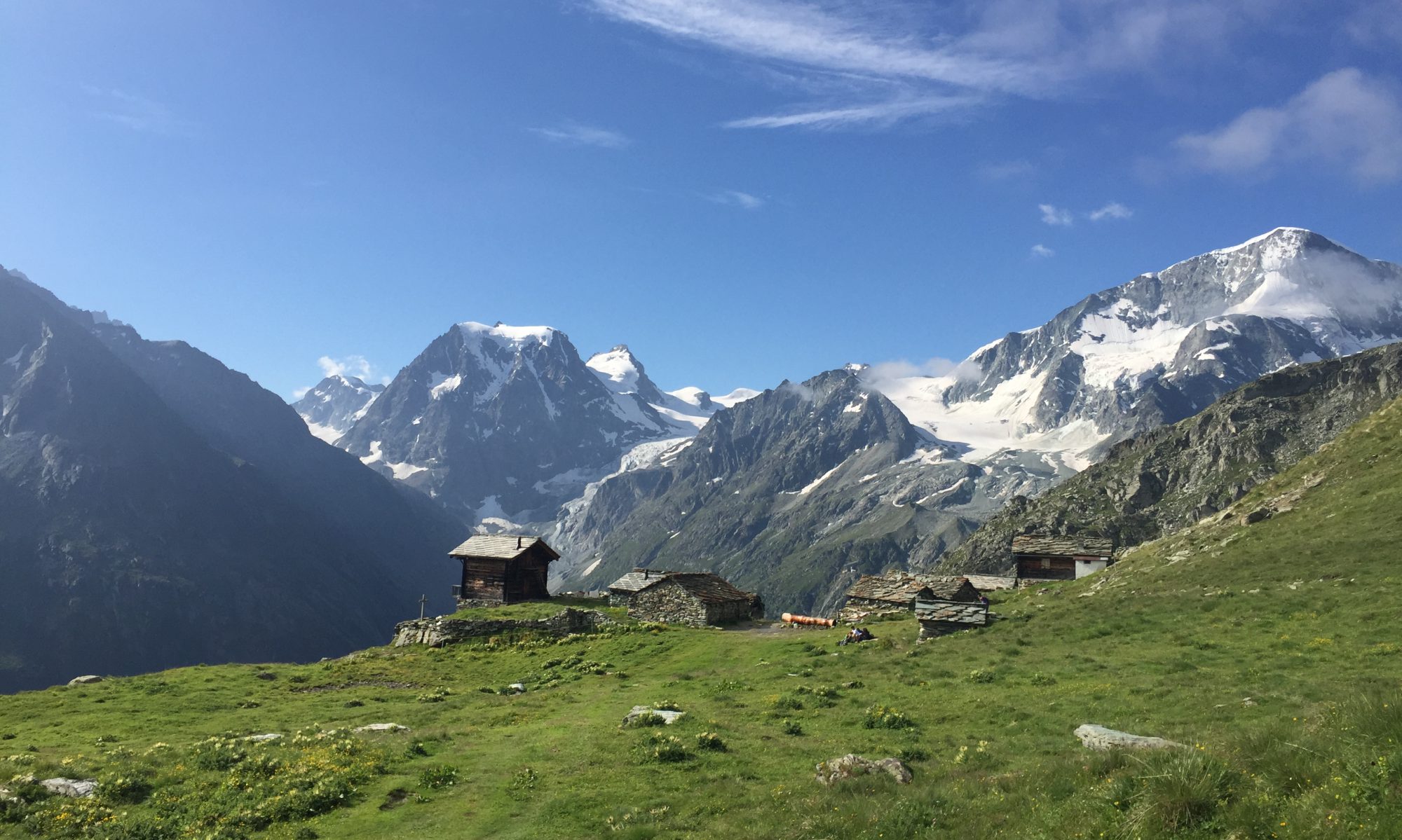
Since swapping the Swiss Alps for the Lake District Fells I have been on a mission to complete ‘The Wainwrights’.
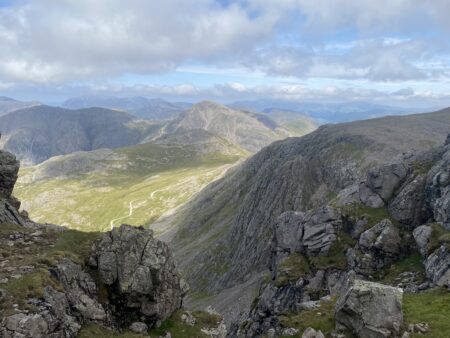
Mention this to everyone around here and they will know what this means, will nod accordingly, and we will fall into a discussion about our respective progress, favourites and interesting routes. For many readers I need to explain a bit further.
Fells are the local name for the mountains and hills in the Lake District and Yorkshire Dales. Fell derives from old Norse fjall. There is an excellent blog here on the difference between mountains and hills, taking in fells, peaks and other terminology.
Alfred Wainwright lived and worked in Kendal and produced seven ‘Pictorial Guide[s] to the Lakeland Fells’, covering different geographic regions. Collectively they describe 214 of the fells. They are works of art with detailed drawings illustrating the routes, landscapes and main features.
Taking in (almost) all of the major fells, they also include some less obvious ones in the landscape. These latter are probably only ever visited by people ‘bagging Wainwrights’ – in fact it’s a common refrain in greeting fellow walkers on these fells to acknowledge that they are there only to ‘tick one more off’. In a sense it’s a highly personal list allegedly chosen so that all the Pictorial Guides are the same thickness.
Many people take decades to complete the Wainwrights. For others it’s a fell-running ultra-challenge that comprises over 300 miles (500km) and the equivalent of climbing Everest four times. The record (as at September 2026) is 5 days 12 hours 14 minutes.
Many years ago I had climbed quite a few Wainwrights, but I started afresh in September 2020. I thought it likely that I would complete them all within seven years. In addition to Wainwright’s own guidebooks there is plenty of guidance available to help with the planning. Peak Bagging Wainwrights is a popular book describing 45 routes to complete all 214. Another book I have describes how to do all 214 in 36 routings (but frankly they are mad routes for mere mortals).
Today, six years on, and after 70 days out on the fells I have one more Wainwright still to do.
There is, I now realise, a whole thing about ‘the last Wainwright’. People plan it (including me). From what I can determine, there are four approaches. The first is to leave an easy Wainwright to the end, so that family members and friends can accompany the walker to achieve the milestone. Quite a few people take the comedy option, finishing on Great End. For others it’s a sentimental ending on Haystacks – Wainwright’s favourite fell. For the rest its Great Gable, a dramatic pyramidal fell that dominates the landscape from a variety of perspectives.
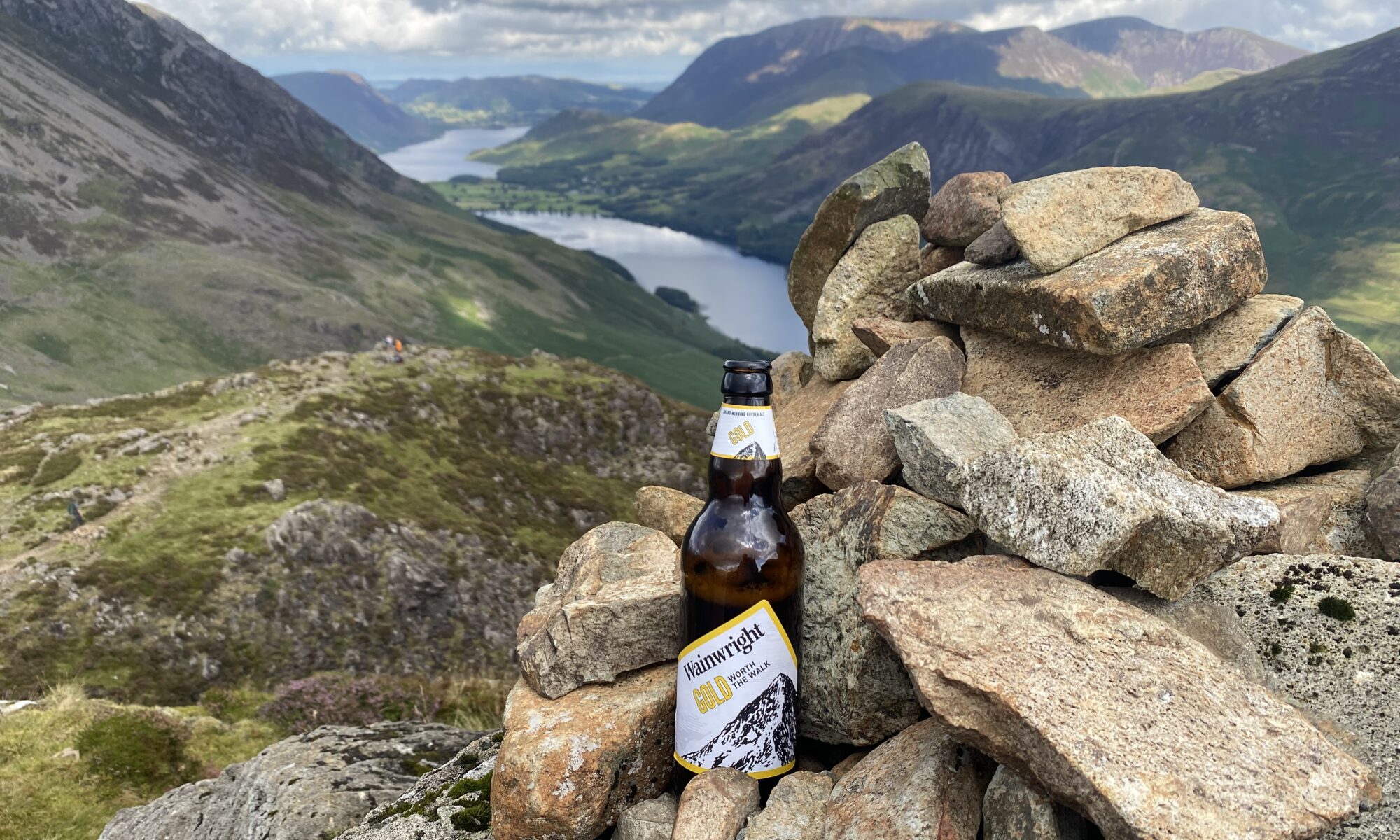
It’s Great Gable for me. Though my penultimate fell was Haystacks; where I sat at the top drinking a bottle of Wainwright Gold enjoying the view and pondering why it was Wainwright’s favourite fell. I’ve yet to meet anyone who has a nice word to say about it, even if the view down to Buttermere is lovely and dramatic (it was the backdrop for a Mission Impossible movie scene).
I’ve been out on the fells pretty much every month of the year (with the exception of February which is when I’m usually off skiing elsewhere). There have been many memorable days – especially in the winter, with snow and ice on the ground and full winter gear on, enjoying clear blue skies.
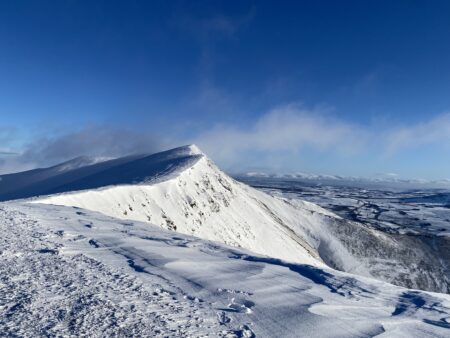
Other standout days were Kirk Fell and Pillar, Blencathra (various times), Scafell via the Waterfall Route, Bowfell via the Slab, and the Fairfield Horseshoe. The ‘big mountain days’ – ridge walks, horseshoe circuits, and iconic summits have generally been with friends – especially with Andrew who lives locally. I have also had a few nights away with friends in the Youth Hostels in Wasdale and Buttermere to make extended expeditions.
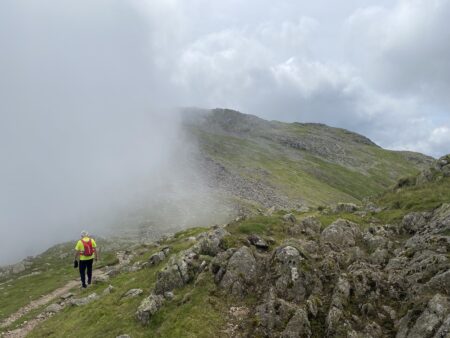
A few words for Scafell Pike too. It may be the highest fell in England but I will be glad not to climb it again. It is an unpleasant jumbled rocky place, and doubly unbearable due to its popularity with people who have no interest in the outdoors except for that social media moment on top of England’s highest.
That said, I have enjoyed the camaraderie of the fells: ‘hello’, ‘hi’, ‘hows it going’, ‘now then’, ‘morning’, and ‘grand day’ are just some of the greetings one hears on the fells. However, nothing can beat the first words of a guy I met halfway up a long approach to one particular fell. Two guys approached on their way down. The first guy stops a little way off me and waits for me to approach. “You must be Tony” he says. Me, slightly bemused, splutter “Er, no”. “Oh that’s funny” he says, “You’re t’only person I’ve seen all day”. His mate behind him sighs.
That dialogue only works in the north of England…
I’ve been very lucky with the weather – it rains 200 days a year in the Lake District, though my records note only five days when I have had to wear rain gear, and only five summits that were covered in mist such that I had no view. Not bad going, and the benefit of living very close to the Lakes and being able to choose when to go walking according to the weather forecast. I do however enjoy the atmospheric days where there is some cloud and the sun breaks out behind it, creating shade and different shafts of light on the fells.
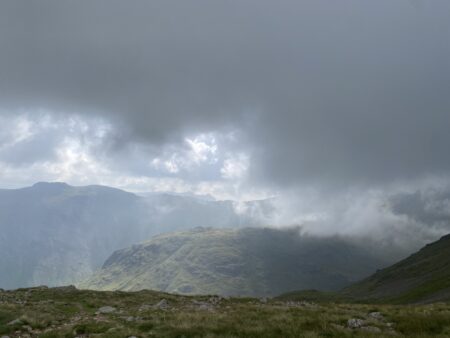
Along the way I improved my winter skills and rock scrambling capabilities.
I did a course with the Fell Top Assessors to refresh my winter skills. The Fell Top Assessors climb Helvellyn every day from December to March reporting on the snow and ice conditions, and advising on equipment needs. It is vital complementary information to the mountain weather forecast, helping keeping people safe on the fells. They combine this with a technical course for punters like me. We climbed straight up a steep snow gully from Red Tarn to the top of Helvellyn.
I was also helped in my endeavour by Vicki at Sports Recovery Kendal, who helped improve my overall fitness, strength and balance, making me more agile and capable on rock scrambling sections. Having struggled for years on exposed mountain sections with a drop to the left, (holding on with my right hand) I came to realise that whilst my conscious brain thought that being right-handed it was the stronger arm, my unconscious brain knew that my right shoulder was damaged and weakened. My unconscious brain tried to steer me away from those situations where I was vulnerable. Vicki also fixed that, so my subconscious and conscious are aligned and I now face exposed routes with confidence.
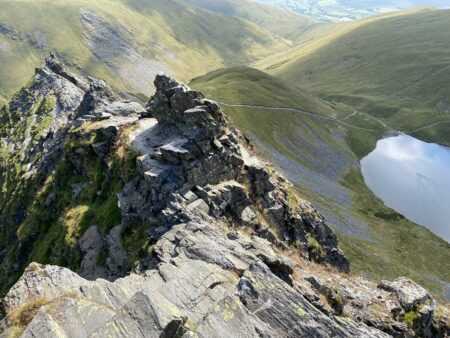
So there is one more to go. Despite being out on the fells pretty much every week this spring and summer, slowly ticking them off, I’m in no rush to do the last one. I’m waiting for the right weather.
And what next? I’m already feeling liberated from the tyranny of ‘bagging Wainwrights’ and looking forward to just planning interesting days out on the fells. Repeating favourites, discovering different routes up and down, climbing those where I didn’t get to see the view and tackling more scrambling routes.
Oh, and there is also the other major listing of Lakeland fells – Birketts. There are 541 of those, rather more objectively chosen than the Wainwrights. They are over 1000ft in altitude and with a prominence of at least 5m (how’s that for mixed metrics?). I shall not be completing those as one Birkett requires ropes and rock climbing capabilities.
But the list at least opens up the mind to new routes and new horizons.